
1. Washington Wizards – AJ Dybantsa
6’9”, 215, SF/PF, BYU, Fr.
2025–26 Stats: 35 GP, 25.5 PPG, 51.0 FG%, 33.1 3P%, 77.4 FT%, 6.8 RPG, 3.7 APG, 1.1 SPG, 0.3 BPG, 3.1 TO
Dybantsa was one of the most consistent and dominant players in college basketball this season, combining elite physical tools with a steadily expanding offensive skill set. A fluid, explosive athlete, he led the nation in scoring while carrying a primary offensive role with strong efficiency. His length, anticipation, and motor translated defensively, where he rotated with purpose, disrupted passing lanes, and effectively guarded multiple positions. Offensively, he functioned as a true point forward, handling comfortably, initiating offense, and creating opportunities for teammates with improving vision and composure.
He reclaimed the top spot on the board following a dominant finish to the season, highlighted by a 35-point performance in the opening round of the NCAA Tournament, even in defeat. The outing reflected the growth he showed throughout the year, particularly as a shot creator and overall offensive weapon. While his perimeter shooting was inconsistent early, his efficiency improved, and he developed a highly reliable mid-range package featuring turnaround jumpers, pull-ups, and counters off the dribble to generate separation. He shot 1.4–4.2 from three (33.1%), and while the percentage and volume still leave room for growth, the trajectory remains encouraging. Dybantsa attacked downhill with power and balance, finished above the rim, rebounded effectively, and comfortably shifted between scoring and facilitating responsibilities. While Darryn Peterson may possess slightly greater long-term upside, Dybantsa was the more productive and dependable player throughout the season, making him the current favorite to be selected first overall.
Why the Wizards select AJ Dybantsa: All signs continue to point toward Dybantsa as the centerpiece of the franchise moving forward. While Peterson could receive legitimate consideration, Dybantsa offers the safer overall profile thanks to his combination of elite physical tools, production, versatility, and no significant durability concerns. At the top of the draft, teams prioritize franchise-changing talent, and Dybantsa checks every box. His ability to impact the game as a scorer, playmaker, defender, and transition weapon gives Washington a foundational piece capable of anchoring every aspect of the rebuild.
NBA Comparison: Tracy McGrady
2. Utah Jazz – Darryn Peterson
6’5”, 200, PG/SG, Kansas, Fr.
2025–26 Stats: 24 GP, 20.2 PPG, 43.8 FG%, 38.2 3P%, 82.6 FT%, 4.2 RPG, 1.6 APG, 1.4 SPG, 0.6 BPG, 1.6 TO
Peterson is a supremely talented scoring guard whose blend of burst, strength, and shot-making gives him arguably the highest offensive ceiling in the class. He features a quick first step, deep pull-up range, and the ability to score at all three levels, consistently putting pressure on defenses both on and off the ball. His positional size and power are further enhanced by an extraordinary 8’7” standing reach, giving him rare physical advantages for a combo guard and legitimate two-way versatility. His perimeter shooting stood out as a major strength, knocking down 2.6-of-6.9 threes per game (38.2%), showcasing advanced shot-making ability and range.
His season, however, was not without questions. Kansas failed to make a deep tournament run, and Peterson finished the year somewhat quietly compared to the lofty expectations that followed him from high school. A mysterious cramping issue impacted portions of his season, affecting both availability and rhythm. While he flashed brilliance throughout the year, the sustained dominance that defined his prep career appeared only in stretches. Even so, his talent level remains undeniable, and few prospects possess his combination of scoring instincts, athletic tools, and upside.
Why the Jazz select Darryn Peterson: Recent reports have linked Utah to Cameron Boozer at No. 2, making this one of the more fascinating situations near the top of the draft. ESPN’s Tim MacMahon reported Wednesday that the Jazz are “strongly considering” Boozer at No. 2, and there are legitimate reasons to believe that could happen. On paper, Utah’s recent roster moves would seem to make Peterson the cleaner fit, as the Jazz still lack a true franchise perimeter creator. However, Peterson’s handling of his cramping issue throughout the season, including an explanation that failed to satisfy some evaluators, along with his reported unwillingness to work out for Utah, could be enough for the Jazz to go in a different direction. The Jazz could envision a jumbo lineup featuring Ace Bailey at shooting guard, Lauri Markkanen at small forward, Cameron Boozer at power forward, and Jaren Jackson Jr. at center, creating one of the biggest and most versatile lineups in the league. That said, Peterson remains the most logical projection. He offers the type of offensive centerpiece every rebuilding organization covets and possesses arguably the highest scoring upside in the class. A trade-down scenario targeting Keaton Wagler or Mikel Brown while adding additional assets could ultimately make more sense than selecting Boozer outright, particularly after acquiring Jackson. But if Utah elects to prioritize star perimeter creation over size and frontcourt versatility, Peterson remains a strong candidate and gives the franchise a potential face of the future.
NBA Comparison: Devin Booker
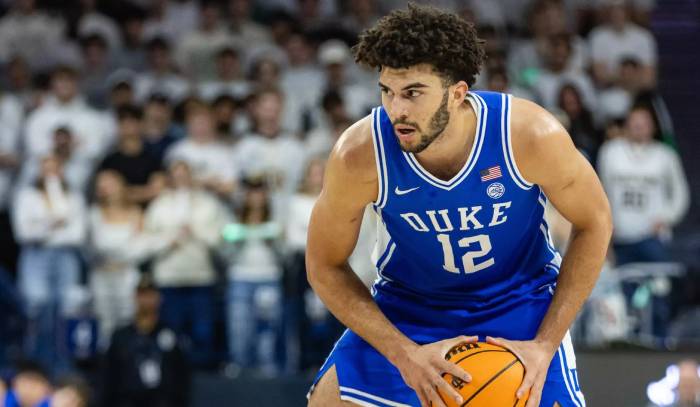
3. Memphis Grizzlies – Cameron Boozer
6’9”, 255, PF, Duke, Fr.
2025–26 Stats: 38 GP, 22.5 PPG, 55.6 FG%, 39.1 3P%, 78.9 FT%, 10.2 RPG, 4.1 APG, 1.4 SPG, 0.6 BPG, 2.5 TO
Boozer was one of the steadiest and most dominant players in college basketball this season, combining strength, touch, motor, and elite fundamentals in a way that consistently translated to winning. A physically ready freshman, he averaged 22.5 points and 10.2 rebounds per game while operating as a face-up scorer, interior finisher, and offensive hub. He led Duke on a deep tournament run, earning National Player of the Year honors while showcasing a mature and polished all-around game.
Though not an explosive athlete, Boozer’s skill level consistently separated him from his peers. He knocked down 39.1% of his three-point attempts while averaging over four assists per game, highlighting his versatility and offensive IQ. His rebounding, toughness, and ability to impact games without relying on elite athleticism give him one of the highest floors in the class. While some scouts question how his physical style will translate against NBA athletes over an 82-game season, his production, feel, and consistency make him one of the safest prospects available.
Why the Grizzlies select Cameron Boozer: Following the trade that sent Jaren Jackson Jr. to Utah, Boozer becomes an especially clean fit for Memphis. One of the league’s more analytically driven organizations, the Grizzlies are likely to value his efficiency, passing, rebounding, and overall feel for the game. Boozer’s ability to contribute immediately while still offering long-term upside makes him a strong fit alongside Ja Morant and gives Memphis another foundational building block moving forward.
NBA Comparison: Al Horford
4. Chicago Bulls – Caleb Wilson
6’10”, 215, PF, North Carolina, Fr.
2025–26 Stats: 24 GP, 19.8 PPG, 57.8 FG%, 25.9 3P%, 71.3 FT%, 9.4 RPG, 2.7 APG, 1.5 SPG, 1.4 BPG, 2.0 TO
Wilson was one of the most productive and impactful freshmen in the country, combining athleticism, efficiency, and defensive versatility to influence games on both ends. A fluid, explosive forward with excellent mobility, he thrived as a transition weapon, rim runner, and face-up scorer. He consistently finished above the rim, attacked closeouts effectively, and created mismatches through speed and activity.
His season was cut short after suffering two broken thumbs, but his body of work firmly established him as one of the premier talents in the class. While his outside shooting remains a work in progress, the touch and mechanics suggest room for growth. Compared to Cameron Boozer, Wilson offers superior athleticism and defensive upside, though Boozer’s polish gives him a slight edge in overall reliability.
Why the Bulls select Caleb Wilson: Chicago continues searching for franchise-level talent and lands one of the highest-upside players in the draft. Wilson’s blend of size, athleticism, defensive versatility, and long-term potential gives the Bulls a potential cornerstone to pair with Matas Buzelis moving forward. While refinement is still needed, the talent level is difficult to overlook.
NBA Comparison: Jermaine O’Neal / Chris Bosh
5. Los Angeles Clippers – Keaton Wagler
6’6”, 185, PG/SG, Illinois, Fr.
2025–26 Stats: 37 GP, 17.9 PPG, 44.5 FG%, 39.7 3P%, 79.6 FT%, 5.1 RPG, 4.2 APG, 0.9 SPG, 0.4 BPG, 1.8 TO
6. Brooklyn Nets – Darius Acuff
6’3”, 190, PG, Arkansas, Fr.
2025–26 Stats: 36 GP, 23.5 PPG, 48.4 FG%, 44.0 3P%, 80.9 FT%, 3.1 RPG, 6.4 APG, 0.8 SPG, 0.3 BPG, 2.2 TO
Acuff emerged as one of the most productive and dynamic lead guards in college basketball, taking a major leap and establishing himself as a true offensive engine. He averaged 23.5 points and 6.4 assists while shooting an elite 44.0% from three on high volume (2.5-of-5.8), showcasing both efficiency and shot-making versatility. A strong, physical guard with excellent pace control, he consistently got downhill, used his tight handle to create separation, and played with the confidence of a true floor general. His ability to generate offense at all three levels, combined with his command and late-game shot creation, made him one of the most dangerous guards in the country. He also emerged as one of the major winners of the pre-draft measurement process, checking in at 6’2” barefoot with a strong 6’7” wingspan and an 8’2.5” standing reach.
He really came into his own as a dominant college player, often looking stronger and more impactful than higher-ranked guards despite giving up size. While undersized by NBA standards and likely to lean offense-first, his upside as a playmaker and shot creator is highly intriguing. Guards his size must be special to overcome physical limitations in today’s game, and Acuff fits that mold, blending elite shooting with creative ball handling, including flashes of the classic Tim Hardaway “UTEP two-step” ability to shake defenders and get into the paint. His combination of production, efficiency, improved measurements, and offensive creativity makes him one of the safest guard bets in the class.
Why the Nets select Darius Acuff: Acuff slipping to No. 6 would represent excellent value for Brooklyn. Much of the movement above him has more to do with Keaton Wagler’s rise than any decline in Acuff’s standing. Mikel Brown remains a legitimate possibility here as well, and some teams may ultimately prefer Brown’s upside. Still, Acuff’s production, shooting, leadership, and ability to run an offense make him an ideal centerpiece for a rebuilding Nets team searching for long-term answers in the backcourt.
NBA Comparison: Tim Hardaway
7. Sacramento Kings – Mikel Brown
6’4”, 190, PG, Louisville, Fr.
2025–26 Stats: 21 GP, 18.2 PPG, 41.0 FG%, 34.4 3P%, 84.4 FT%, 3.3 RPG, 4.7 APG, 1.2 SPG, 0.1 BPG, 3.1 TO
Brown remained one of the most skilled and intriguing lead guards in the 2026 class, controlling tempo with poise and playing with a quiet confidence that consistently showed up in his decision-making. More quick and shifty than outright fast, he excelled at creating separation through change of pace, hesitation moves, and advanced ball handling. He generated offense efficiently out of ball screens, where his pull-up shooting and shot creation stood out, highlighted by a 45-point performance against NC State in which he knocked down 10-of-16 from three. Despite shooting 34.4% from deep, the raw percentage undersells his actual shooting ability, as many evaluators still view him as one of the most gifted perimeter shooters in the class based on shot difficulty, mechanics, and touch.
Durability remains part of the evaluation after back issues impacted portions of his high school and college career, though recent feedback throughout the pre-draft process has generally been encouraging. On our board, Brown ranks significantly higher than where he is projected here and grades out as one of the premier talents in the entire class. His combination of shot creation, perimeter shooting, pace, feel for the game, and offensive creativity is exceptionally advanced for a player his age. If the durability concerns ultimately prove minor, Brown has the type of talent that could make this draft position look far too low in hindsight. Among players projected outside the top five, few possess a stronger case to eventually emerge as one of the elite players from the 2026 NBA Draft.
Why the Kings select Mikel Brown: Sacramento lands one of the biggest upside swings in the lottery with Brown, a dynamic lead guard whose talent level exceeds where he is projected here. On our board, Brown grades out considerably higher than No. 7 and possesses the type of offensive skill set that could eventually make him one of the best players in this draft class. His advanced shot creation, perimeter shooting, playmaking instincts, and ability to operate at varying speeds give him the tools to develop into a true offensive centerpiece. While some uncertainty remains regarding long-term durability, recent indications have generally been positive, making this a gamble well worth taking for a Kings franchise searching for star power.
NBA Comparison: CJ McCollum
8. Atlanta Hawks (from New Orleans) – Brayden Burries
6’4”, 185, PG/SG, Arizona, Fr.
2025–26 Stats: 39 GP, 16.1 PPG, 49.1 FG%, 39.1 3P%, 80.5 FT%, 4.9 RPG, 2.4 APG, 1.5 SPG, 0.2 BPG, 1.5 TO
Burries established himself as one of the most productive and efficient freshman guards in the country, leading a No. 1 seed Arizona team in scoring while playing a key role in a dominant season. A strong, controlled combo guard, he played with excellent pace and balance, scoring efficiently at all three levels while making smart decisions within the flow of the offense. He proved comfortable both on and off the ball, consistently showing maturity in his shot selection and overall approach. His consistency throughout the year helped Arizona remain among the nation’s elite teams and highlighted a level of polish uncommon for a freshman.
He did struggle on the biggest stage in the Final Four against Michigan, where foul trouble and an inefficient performance limited his impact. Scouts, however, are unlikely to overreact given his body of work. Burries competes defensively, rebounds well for his position, and plays with toughness and feel. While continuing to improve his ability to create separation against elite athletes will be important, he projects as one of the safer guards in the class with the versatility to fit into almost any system.
Why the Hawks select Brayden Burries: Atlanta begins its post-Trae Young era by adding one of the most complete guards in the draft. Burries offers a strong blend of upside and reliability, with the ability to play either backcourt spot and impact winning without dominating the ball. His shooting, decision-making, toughness, and two-way competitiveness make him a clean fit for a Hawks team still shaping its future identity. While players with greater raw upside remain available, Burries provides a high-level foundation piece capable of fitting alongside a variety of roster constructions.
NBA Comparison: Jrue Holiday
9. Dallas Mavericks – Kingston Flemings
6’4”, 185, PG, Houston, Fr.
2025–26 Stats: 37 GP, 16.1 PPG, 47.6 FG%, 38.7 3P%, 84.5 FT%, 4.1 RPG, 5.2 APG, 1.5 SPG, 0.3 BPG, 1.8 TO
Flemings emerged as one of the most impactful freshman lead guards in the country, pairing elite athleticism with improving efficiency and growing command of Houston’s offense. An explosive downhill creator with a tight handle and excellent burst, he consistently generated penetration and finished above the rim with strength and creativity. He showed real progress as a perimeter shooter, converting 38.7% from three while maintaining strong efficiency from the free throw line. He played with confidence and edge as Houston’s primary initiator, showing comfort pulling up, collapsing defenses, and making timely reads out of ball screens while posting an impressive assist-to-turnover ratio.
Flemings arguably possesses the highest athletic ceiling among the point guards in this class. His explosiveness, first step, and ability to pressure defenses create tremendous upside, though he remains somewhat less polished than the guards selected ahead of him. His jumper has improved significantly, but continuing to develop as a consistent perimeter threat will be critical. Even so, his competitiveness, toughness, and overall talent make him one of the more intriguing long-term bets in the lottery.
Why the Mavericks select Kingston Flemings: While Flemings reportedly performed well throughout the pre-draft process, including a notable head-to-head workout against Keaton Wagler for the Clippers, Los Angeles ultimately appears to have leaned toward Wagler’s shooting and overall offensive polish. Dallas benefits from that decision, landing one of the draft’s premier athletes at No. 9. Pairing Flemings with Cooper Flagg gives the Mavericks a dynamic lead guard prospect capable of generating downhill pressure and creating offense at a high level. The long-term upside of that combination is extremely appealing.
NBA Comparison: De’Aaron Fox
10. Milwaukee Bucks – Nate Ament
6’11”, 205, SF/PF, Tennessee, Fr.
2025–26 Stats: 35 GP, 16.7 PPG, 39.9 FG%, 33.3 3P%, 79.0 FT%, 6.3 RPG, 2.3 APG, 1.0 SPG, 0.6 BPG, 2.3 TO
Ament has cemented himself as one of the more intriguing long-term prospects in the freshman class, combining size, mobility, and perimeter skill at nearly 6’11”. A smooth, fluid forward, he fits the modern NBA mold as a big wing capable of spacing the floor, attacking closeouts, and contributing across multiple areas. His production grew as his role expanded, and he showed the ability to score at multiple levels while contributing on the glass and flashing connective passing ability. He also displayed surprising toughness throughout the season, getting to the free throw line at a high rate and helping alleviate some of the early concerns surrounding his physicality.
The next step in his development is adding strength, consistency, and greater offensive assertiveness. His three-point shooting was somewhat underwhelming relative to expectations, but the mechanics and touch suggest it can become a real strength over time. He can still be knocked off spots by stronger defenders and will need to continue improving his ability to create separation in the half court. Defensively, he showed encouraging versatility with his length and mobility, even as his technique continues to develop. With added strength and continued growth, Ament projects as one of the higher-upside forwards in the class.
Why the Bucks select Nate Ament: Milwaukee swings on upside and long-term value by selecting one of the most physically gifted forwards in the draft. Ament’s combination of size, mobility, defensive versatility, and offensive potential gives him a ceiling few players outside the top five can match. With the franchise widely expected to navigate an inevitable Giannis Antetokounmpo trade at some point this offseason, the Bucks must begin prioritizing long-term building blocks alongside any assets acquired in a potential deal. Ament offers exactly the type of high-ceiling talent worth betting on during a transitional period. His physical tools and developmental upside give Milwaukee a chance to add a future cornerstone while maintaining flexibility as the organization reshapes its roster and charts its next era.
NBA Comparison: Lamar Odom / Jonathan Isaac
11. Golden State Warriors – Hannes Steinbach
6’10”, 240, PF, Washington Fr.
2025–26 Stats: 30 GP, 18.5 PPG, 57.7 FG%, 34.0 3P%, 75.9 FT%, 11.8 RPG, 1.6 APG, 1.1 SPG, 1.2 BPG, 2.0 TO
Steinbach established himself as one of the most productive and physically imposing freshman big men in the country, combining strength, skill, and feel in a package that consistently translated to winning basketball. At 6’11” and 250 pounds, he already possesses an NBA-ready frame and routinely overwhelmed opponents with his combination of size, toughness, and interior scoring ability. He carved out deep position, finished through contact, and consistently generated high-efficiency offense around the basket. Despite his youth, he played with a maturity and composure uncommon for a freshman big, showing patience as a scorer and a willingness to make the extra pass when defenses collapsed.
While much of his production came around the rim, Steinbach also flashed intriguing perimeter skill and offensive versatility. He demonstrated solid passing instincts, averaging 2.8 assists per game, and showed comfort facilitating from the elbows and high post. His outside shot remains a work in progress after converting 29.4% from three, but the mechanics and touch suggest room for future growth. Defensively, he relied more on positioning, anticipation, and strength than elite athleticism, but still managed to impact games as a rebounder and rim protector. His combination of size, feel, skill, and production gives him one of the higher floors among frontcourt prospects in the class while still leaving room for considerable upside.
Why the Warriors select Hannes Steinbach: Golden State remains focused on maximizing what remains of the Stephen Curry era while also identifying long-term building blocks for the future. Steinbach offers a unique blend of readiness and upside, making him an appealing fit for both timelines. His passing ability, basketball IQ, rebounding, and interior scoring should translate well within Steve Kerr’s motion offense, while his developing perimeter game gives him additional long-term appeal. The Warriors have historically valued intelligent, skilled big men who can facilitate offense and keep the ball moving, making Steinbach a particularly natural fit. If his shooting continues to develop, he has a chance to become one of the more impactful frontcourt players from this draft class. Another name to watch here is Brayden Burries, who has a workout scheduled with Golden State. Should Burries slide farther than expected on draft night, the Warriors could emerge as a potential backstop given his scoring ability, versatility, and long-term upside on the wing.
NBA Comparison: Alperin Sengun / Domantas Sabonis
12. Oklahoma City Thunder (from LA Clippers) – Cameron Carr
6’5”, 190, SG/SF, Tennessee, Jr.
2025–26 Stats: 34 GP, 18.9 PPG, 49.4 FG%, 37.4 3P%, 80.1 FT%, 5.8 RPG, 2.6 APG, 0.9 SPG, 1.3 BPG, 2.4 TO
Carr put together one of the more impressive breakout seasons among returning wings, emerging as a primary option after two quiet years at Tennessee where he struggled to find consistent opportunity. He made a major leap, showcasing his athleticism and skill set while averaging nearly 19 points per game with strong efficiency. A long, explosive athlete, he consistently attacked the rim and delivered highlight finishes, while also rediscovering the shooting ability that made him a highly regarded prospect out of high school. He converted 2.3-of-6.1 threes per game (37.4%), showing both volume and confidence as a perimeter scorer.
There are still areas for growth, particularly adding strength and toughness to better handle physical play, and his 2.4 turnovers per game stand out as an area that needs improvement as he continues to refine his decision-making. That said, the upside is significant. Carr flashes high-level three-and-D potential, with strong catch-and-shoot ability and the length and athleticism to disrupt passing lanes and guard multiple positions. While his development path took time, his breakout season reinforced his long-term upside as a two-way wing, and he has emerged as one of the biggest risers of the pre-draft process.
Why the Thunder select Cameron Carr: Oklahoma City has earned a reputation as one of the league’s premier player-development organizations, making Carr an especially intriguing fit. One of the biggest winners of the pre-draft process, Carr offers the type of athletic upside, shooting ability, and positional versatility that has become a hallmark of the Thunder’s roster-building philosophy. With an already loaded young core in place, Oklahoma City can afford patience while allowing Carr to continue refining his game. His combination of length, explosiveness, perimeter shooting, and defensive upside could eventually make him one of the better value picks in the lottery.
NBA Comparison: Zach LaVine
13. Miami Heat – Karim Lopez
6’8”, 205, SF, Mexico, Intl. (New Zealand Breakers – NBL)
2025–26 Stats: 31 GP, 11.9 PPG, 50.2 FG%, 32.6 3P%, 71.7 FT%, 6.1 RPG, 2.0 APG, 1.2 SPG, 1.0 BPG, 3.0 TO
Lopez emerged as one of the more intriguing international wing prospects, offering a rare combination of size, fluid shooting mechanics, and all-around production while competing in Australia’s NBL. At 6’8”, he has an ideal frame for a modern wing, and his smooth perimeter stroke and confidence suggest more upside as a shooter than his 32.6% three-point percentage would indicate. There are flashes of a Klay Thompson-type profile in his size and pure shooting ability, though he is not yet close to that level of consistency. He contributed across the board with rebounding, defensive activity, and efficient finishing, showing a well-rounded foundation against professional competition.
The evaluation still hinges on consistency, toughness, and overall impact. His performance at events such as Adidas Eurocamp was uneven, and there are stretches where he can fade into the background. While his tools and shooting upside are clearly appealing, teams will want to see a more consistent motor and physical edge. Even so, Lopez remains one of the more intriguing international upside swings outside the lottery and possesses a skill set that fits the modern NBA extremely well.
Why the Heat select Karim Lopez: Miami has long prioritized versatile wings with size, skill, and developmental upside, making Lopez a natural fit. His ability to space the floor, attack closeouts, and contribute across multiple positions gives the Heat another intriguing young piece to develop. Miami has consistently shown confidence in its player-development infrastructure, and Lopez’s combination of size, shooting potential, and professional experience makes him an appealing investment. If his consistency improves, he has the upside to significantly outperform this draft position.
NBA Comparison: Zaccharie Risacher
14. Charlotte Hornets – Aday Mara
7’4”, 255, C, Michigan, Jr.
2025–26 Stats: 40 GP, 23.4 MIN, 66.8 FG%, 30.0 3P%, 56.4 FT%, 6.8 RPG, 2.4 APG, 2.6 BPG, 0.4 SPG, 2.2 PF, 2.0 TO, 12.1 PPG
Mara played a major role in Michigan’s National Championship run, delivering some of his best basketball during the NCAA Tournament and emerging as one of the more intriguing long-term big men in the class. A former elite European prospect from Spain who initially struggled to fully adjust during his first two seasons at UCLA, Mara finally began putting everything together in a larger role at Michigan. Coming from a family of athletes, he possesses impressive coordination and feel for a player with his massive frame, showing advanced touch, passing instincts, and offensive IQ uncommon for a player his size. He further impressed evaluators during the pre-draft process by measuring a massive 7’3” barefoot with an enormous 9’9” standing reach.
Offensively, Mara thrives as a rim runner, interior finisher, and connective passer, shooting an outstanding 66.8% from the field while also flashing occasional perimeter touch. His 2.4 assists per game highlight his vision and ability to facilitate offense from the high post or short roll. Defensively, Mara’s length and timing make him a major rim protection presence, averaging 2.6 blocks per game while altering countless additional shots around the basket. There are still concerns regarding mobility, perimeter defense, and overall athleticism in space, but few prospects in the class can match his combination of size, feel, and production. Green room buzz has continued to build in recent weeks, and there is growing belief that Mara could ultimately hear his name called even earlier than this.
Why the Hornets select Aday Mara: Charlotte continues building around LaMelo Ball and Brandon Miller, and Mara gives the organization a potential long-term answer in the middle. His size, passing ability, and rim protection provide a skill set that is difficult to find, while his continued development at Michigan showed meaningful progress. The Hornets can afford patience with his development, allowing him to grow into a larger role over time. If everything comes together, Mara possesses one of the highest ceilings among the big men in this class.
NBA Comparison: Luke Kornet / Khaman Maluach
15. Chicago Bulls (via Trailblazers) – Labaron Philon
6’4”, 185, PG, Alabama, So.
2025–26 Stats: 33 GP, 22.0 PPG, 50.1 FG%, 39.9 3P%, 79.8 FT%, 3.5 RPG, 5.0 APG, 1.2 SPG, 0.2 BPG, 2.5 TO
Philon built on an impressive freshman campaign to become one of the most productive and dynamic guards in college basketball, making a major leap in both volume and efficiency. He averaged 22.0 points and 5.0 assists while dramatically improving as a three-point shooter, converting 39.9% from deep after hitting just 31.5% as a freshman. His development as a pick-and-roll operator stood out, showing improved pace, control, and the ability to manipulate defenders while consistently creating scoring opportunities for himself and others. With good positional size, elite end-to-end speed, and a strong first step, he applied constant pressure on defenses and emerged as a true offensive engine.
Philon plays with a brash, competitive edge, embracing physicality and never shying away from challenges. His confidence and toughness are major strengths, though his aggressive style can occasionally lead to turnovers and overextension as a decision-maker. Even so, his combination of scoring punch, improved shooting, and playmaking growth makes him one of the more intriguing backcourt prospects in the class. If he continues refining his decision-making, he projects as a high-level offensive guard capable of thriving in a modern NBA system.
Why the Bulls select Labaron Philon: After selecting Caleb Wilson at No. 4, Chicago turns its attention to the backcourt and lands one of the most productive guards in the class. Philon gives the Bulls a potential long-term lead guard capable of creating offense, pressuring defenses, and growing alongside Wilson and Matas Buzelis. His confidence, scoring ability, and playmaking upside provide Chicago with another foundational piece as the organization continues building toward a new era.
NBA Comparison: Dejounte Murray
16. Memphis Grizzlies (via Magic) – Morez Johnson
6’9”, 235, PF/C, Michigan, So.
2025–26 Stats: 40 GP, 13.1 PPG, 62.3 FG%, 34.3 3P%, 78.2 FT%, 7.3 RPG, 1.2 APG, 0.7 SPG, 1.1 BPG, 1.3 TO
Johnson played a key role in Michigan’s National Championship run, providing interior toughness, efficiency, and consistent energy throughout the season. He averaged 13.1 points on an impressive 62.3% shooting, showing his ability to finish through contact and convert high-percentage opportunities. His impact was especially evident during the NCAA Tournament, where he consistently delivered strong performances against top competition. He thrived as a rebounder, rim finisher, and physical presence, regularly doing the dirty work and generating winning plays.
While his offensive game is still developing, there are encouraging signs of growth. He showed flashes of face-up ability and perimeter shooting, while his strong free throw percentage suggests additional offensive upside. Defensively, he proved capable as a help defender, protecting the rim and switching in spurts. His combination of toughness, motor, and championship pedigree has helped solidify his standing as a likely first-round pick.
Why the Grizzlies select Morez Johnson: Few organizations value toughness, rebounding, physicality, and winning basketball more than Memphis. Johnson checks all of those boxes. Fresh off a National Championship run, he gives the Grizzlies another rugged frontcourt player capable of impacting games without needing touches. His mentality, efficiency, and willingness to embrace a role fit perfectly with the culture Memphis has built.
NBA Comparison: Daniel Gafford
17. Oklahoma City Thunder (via Philadelphia) – Yaxel Lendeborg
6’10”, 240, PF/C, Michigan, Sr.
2025–26 Stats: 40 GP, 15.1 PPG, 51.5 FG%, 37.2 3P%, 82.4 FT%, 6.8 RPG, 3.2 APG, 1.1 SPG, 1.2 BPG, 1.1 TO
Lendeborg remained one of the more unique and versatile senior prospects in the class, offering an uncommon blend of size, passing, and overall feel. In his first season at Michigan, he played a key role in helping guide the Wolverines to a National Championship, elevating his draft stock into the lottery conversation at various points during the season. While his scoring production dipped compared to his UAB days, his all-around impact and connective skill set stood out. He operated comfortably from the elbows and short roll, facilitating offense and keeping the ball moving while also developing into a legitimate floor-spacing threat. His improved perimeter shooting was one of the biggest developments in his game, converting 37.2% from three on solid volume.
There are still some mixed elements in his evaluation. His free throw rate was somewhat underwhelming relative to his physical tools, and teams will want to see more consistent offensive assertiveness and defensive reliability against NBA-level athletes. At 24 years old, his age naturally limits some of the long-term upside associated with younger prospects. However, his maturity, versatility, winning impact, and ability to contribute in a variety of ways make him one of the safer players in the class. His slide is much more about age than talent.
Why the Thunder select Yaxel Lendeborg: If Oklahoma City ultimately keeps both first-round selections, landing Carr and Lendeborg would represent a strong blend of upside and readiness. Lendeborg fits the Thunder’s preference for versatile, high-IQ players who impact winning without needing heavy usage. His passing, floor spacing, defensive versatility, and championship experience make him a strong fit within Oklahoma City’s system. While younger prospects may offer more theoretical upside, few players available in this range have proven they can contribute to winning at the level Lendeborg has.
NBA Comparison: OG Anunoby
18. Charlotte Hornets (via Magic, Suns) – Isaiah Evans
6’6”, 180, SG/SF, Duke, So.
2025–26 Stats: 38 GP, 15.0 PPG, 43.3 FG%, 36.1 3P%, 86.0 FT%, 3.2 RPG, 1.3 APG, 0.7 SPG, 0.7 BPG, 1.1 TO
Evans showed strong sophomore progression, displaying improved confidence and offensive polish while emerging as one of Duke’s primary perimeter scoring threats. He made a significant jump in production and delivered several strong performances during the NCAA Tournament, reinforcing his upside as a scorer. A smooth, natural shot-maker, he expanded beyond a spot-up role, adding a more reliable mid-range game, improved finishing through contact, and flashes of secondary creation. His length and high release allow him to generate clean looks over defenders, while his movement shooting remains one of his biggest strengths.
The swing factor in his evaluation remains physical development. Adding strength and muscle will be critical to unlocking additional aspects of his game, including rebounding, defense, and playmaking. While some evaluators question whether he currently impacts enough areas beyond scoring, his combination of length, shooting touch, and offensive instincts remains highly appealing. If his body continues to develop, Evans has a pathway to becoming one of the better scoring wings from this class.
Why the Hornets select Isaiah Evans: Charlotte continues adding perimeter talent around LaMelo Ball and Brandon Miller, and Evans fits naturally within that vision. His ability to space the floor, move without the ball, and create secondary offense gives the Hornets another dynamic scoring option. With Miller already established as a cornerstone wing, Evans can develop without immediate pressure while learning how to impact games within a complementary role. The upside as a long, fluid perimeter scorer makes this a strong value play in the late teens.
NBA Comparison: Brandon Ingram
19. Toronto Raptors – Christian Anderson
6’2”, 180, PG, Texas Tech, So.
2025–26 Stats: 33 GP, 18.5 PPG, 47.2 FG%, 41.5 3P%, 80.5 FT%, 3.6 RPG, 7.4 APG, 1.5 SPG, 0.2 BPG, 3.3 TO
Anderson put together a major sophomore season, emerging as one of the most productive and efficient lead guards in college basketball. Despite standing just 6’2”, he consistently controlled games with pace, feel, and advanced pick-and-roll play. He excelled at creating opportunities for both himself and teammates, averaging 7.4 assists per game while maintaining excellent shooting efficiency. His 41.5% three-point shooting gives him legitimate floor-spacing value, and his ability to organize an offense consistently stood out throughout the season.
His size will naturally remain one of the primary questions evaluators focus on, as smaller guards must prove they can survive defensively at the NBA level. However, Anderson compensates with skill, toughness, decision-making, and basketball IQ. Born April 2, 2006, and holding dual citizenship in the United States and Germany, he remains relatively young for a sophomore and offers more upside than many realize. His combination of production, efficiency, and feel makes him one of the more analytically appealing guards in the class.
Why the Raptors select Christian Anderson: Toronto continues investing in skill, shooting, and decision-making by selecting one of the most polished guards available. Anderson’s ability to organize an offense, shoot from deep, and consistently make the correct read should fit well alongside Scottie Barnes, Brandon Ingram, and the rest of Toronto’s young core. His combination of production and efficiency makes him one of the better values available at this stage
NBA Comparison: Darius Garland
20. San Antonio (via Hawks) – Allen Graves
6’9”, 225, SF/PF, Santa Clara, Fr.
2025–26 Stats: 35 GP, 11.8 PPG, 51.2 FG%, 41.3 3P%, 75.0 FT%, 6.5 RPG, 1.8 APG, 1.9 SPG, 0.9 BPG, 0.7 TO
Graves has emerged as one of the more intriguing analytics standouts in the class, producing highly efficient and well-rounded numbers despite coming off the bench for Santa Clara. A former point guard, he brings advanced feel, ball handling, and passing instincts for his size, allowing him to function as a connective piece offensively rather than a primary scorer. His defensive activity stands out, averaging nearly two steals and close to a block per game, showcasing his anticipation, length, and versatility. He also knocked down 1.1–2.6 threes per game (41.3%), a strong volume considering his role, giving him legitimate floor-spacing value to pair with his all-around impact.
He had a brief NCAA Tournament moment, delivering a clutch performance before Santa Clara was knocked out on a buzzer beater by Kentucky, slightly overshadowing his impact. Physically, he still has room to develop and become more assertive offensively, but his combination of size, efficiency, defensive instincts, and versatility is highly appealing. With his age, dimensions, and unique background, Graves has significant upside remaining and projects as a high-level connector at the next level, with the potential to grow into a much bigger role over time.
Why the Spurs select Allen Graves: This feels like a very Spurs-type selection. Graves offers the basketball IQ, versatility, unselfishness, and feel that San Antonio has historically valued. His ability to defend multiple positions, move the ball, and contribute without requiring touches should fit naturally alongside Victor Wembanyama and the Spurs’ growing core. For a franchise that has consistently prioritized smart, winning players, Graves checks a lot of boxes.
NBA Comparison: Boris Diaw / Kyle Anderson
21. Detroit Pistons (via Timberwolves) – Bennett Stirtz
6’4”, 185, PG, Iowa, Sr.
2025–26 Stats: 37 GP, 19.8 PPG, 47.7 FG%, 35.8 3P%, 84.8 FT%, 2.6 RPG, 4.4 APG, 1.4 SPG, 0.2 BPG, 1.8 TO
Stirtz proved his production translated seamlessly to the Big Ten, leading Iowa on a deep tournament run with a scrappy roster while continuing to produce at a high level. He played with excellent pace and composure, consistently making quick reads and organizing the offense, with his passing and facilitation standing out as a major strength. He also showed solid three-point volume at 2.5–6.9 per game (35.8%), reinforcing his ability to space the floor and keep defenses honest. His ability to overachieve against more athletic competition underscored his feel, competitiveness, and leadership, as he controlled games without forcing action and consistently elevated teammates.
There are still questions about how his game translates physically at the NBA level, particularly in terms of size, speed, and athleticism, but his intangibles and steady improvement are difficult to ignore. After progressing from the Division II level to Drake and then Iowa, he continued to get better each step of the way. His shooting, decision-making, and toughness give him a strong foundation as a rotation guard, and while his upside may be limited compared to younger prospects, his competitiveness, determination, and feel for the game should allow him to carve out a role.
Why the Pistons select Bennett Stirtz: Detroit continues building around Cade Cunningham and adds one of the more polished floor generals in the class. Stirtz’s shooting, passing, competitiveness, and ability to stabilize an offense make him an appealing addition to a young roster still looking to improve its overall decision-making and backcourt depth. While he may not possess the upside of some younger prospects, his feel and readiness could allow him to contribute relatively early.
NBA Comparison: Steve Blake
22. Philadelphia 76ers (via Thunder, Rockets) – Chris Cenac
6’11”, 240, PF/C, Houston, Fr.
2025–26 Stats: 37 GP, 9.5 PPG, 48.5 FG%, 33.3 3P%, 62.1 FT%, 7.9 RPG, 0.7 APG, 0.8 SPG, 0.5 BPG, 0.9 TO
Cenac remained one of the more intriguing long-term big men in the class, offering a rare blend of size, mobility, and emerging perimeter skill for a 6’11” frontcourt prospect. His role within Houston’s structured system kept his scoring numbers modest, but his impact showed up through energy plays, rebounding, and efficient finishing around the rim. He ran the floor extremely well, played above the rim as a vertical threat, and flashed the ability to step out and hit perimeter shots. While his three-point numbers did not jump off the page, the form and touch suggest real long-term shooting potential, reinforcing his appeal as a modern floor-spacing big.
The overall production was somewhat underwhelming, highlighting that he is more of an upside selection who may take time to develop. His low block numbers also stand out as a concern, pointing to an area where he can improve as a rim protector. His consistency and defensive presence are still evolving, and continued strength gains will be important for him to handle physical matchups and anchor the paint more effectively. Even so, the combination of size, athleticism, and skill is difficult to ignore. Cenac’s development curve may be longer than some peers, but his tools and flashes of shooting and mobility give him significant long-term potential.
Why the Sixers select Chris Cenac Philadelphia takes a long-term view and invests in one of the more gifted frontcourt prospects available. Cenac’s size, mobility, rim protection, and emerging offensive skill set give him substantial upside if developed properly. With the ability to learn behind veteran players and develop without immediate pressure, this could prove to be one of the better value selections in the latter half of the first round.
NBA Comparison: Kel’el Ware
23. Atlanta Hawks (via Cavaliers) – Meleek Thomas
6’5”, 185, PG/SG, Arkansas, Fr.
2025–26 Stats: 37 GP, 15.6 PPG, 43.5 FG%, 41.6 3P%, 84.3 FT%, 3.8 RPG, 2.5 APG, 1.5 SPG, 0.2 BPG, 1.0 TO
Thomas established himself as a natural scorer with a unique, unorthodox herky-jerky style that made him difficult to contain. He played with excellent pace and craft, using hesitation moves, sudden bursts, and long strides to create separation. His perimeter shooting was a major strength, knocking down 2.2–5.3 threes per game (41.6%) while also converting over 84% from the line, reinforcing his high-level scoring profile. Physically, he made significant strides over the course of the season, adding strength and appearing more filled out, a testament to Arkansas’ strength and conditioning program, which helped him better absorb contact and finish plays.
While he projects more as a combo guard than a true lead, his scoring instincts and shot-making ability give him clear value. Defensively, he showed active hands and competitiveness, and his low turnover rate reflected solid decision-making for a freshman. There is still room to grow in terms of playmaking and overall consistency, but his offensive skill set, improved frame, and ability to generate efficient scoring make him a strong sleeper candidate in this range with the potential to outperform his draft position.
Why the Hawks select Meleek Thomas: After landing Brayden Burries earlier in the lottery, Atlanta doubles down on perimeter talent by selecting one of the better pure scorers in the class. Thomas gives the Hawks another offensive weapon capable of creating his own shot, spacing the floor, and providing instant scoring punch. His ability to play both on and off the ball should fit well alongside Burries and the rest of Atlanta’s young core, giving the organization another upside swing as it continues reshaping the roster.
NBA Comparison: Leandro Barbosa / Jordan Hawkins
24. New York Knicks – Joshua Johnson
6’9”, 240, F, Iowa State, Sr.
2025–26 Stats: 35 GP, 30.9 MPG, 16.4 PPG, 7.4 RPG, 4.8 APG, 1.6 SPG, 0.8 BPG, 47.1% FG, 34.5% 3P%, 70.0% FT
Johnson is a strong, skilled point forward type who brings a mature, well-rounded game and the versatility to contribute immediately. At 6’9”, 240 pounds, he has the size and strength to match up at either forward spot, using his physicality and toughness to hold his own defensively and on the glass. His best attribute is his passing, as he consistently makes advanced reads, facilitates offense from the high post or perimeter, and keeps the ball moving with purpose. While not an explosive athlete, he compensates with feel, positioning, and skill, showing the ability to handle, create in a secondary role, and knock down perimeter shots at a respectable rate. His production across the board—particularly as a rebounder and playmaker—highlights his impact as a connector who fills gaps and elevates team play.
Why the Knicks select Joshua Johnson: Fresh off capturing the NBA championship, New York enters the draft focused on maintaining its title window while continuing to add depth around an established core. Joshua Johnson projects as the type of ready-made contributor who fits seamlessly within the culture the organization has built. His toughness, versatility, and willingness to impact games without dominating the ball align perfectly with the Knicks’ identity. Johnson’s ability to facilitate offense from the frontcourt, make smart decisions, and defend multiple positions should allow him to carve out a role quickly on a team looking to defend its championship. Adding a mature, team-oriented player with a versatile skill set makes considerable sense for a contender seeking affordable contributors capable of helping immediately.
NBA Comparison: Joe Ingles / Josh Giddey
25. Los Angeles Lakers – Jayden Quaintance
6’10”, 250, PF/C Kentucky, So.
Stats (4 GP): 5.0 PPG, 5.0 RPG, 0.5 APG, 57.1 FG%, 0.0 3P%, 30.8 FT%
Quaintance is one of the more physically gifted frontcourt prospects in the class, bringing strength, explosiveness, and a high motor to the interior. A transfer from Arizona State who was not draft-eligible as a freshman, he entered the season with significant buzz but has struggled to stay on the floor due to injuries and limited availability. When healthy, his physical upside is evident. He plays above the rim, looks to finish everything with force, and impacts the game through energy, rebounding, and defensive activity. He further boosted his profile during the pre-draft process by measuring a massive 7’5.25” wingspan at the NBA Draft Combine, confirming true center size and exceptional length on a 6’10” frame. His tools, strength, and athleticism give him the foundation of a modern role-playing big who can run the floor, protect the paint, and provide physical presence.
Offensively, Quaintance remains a work in progress. While he shows occasional touch around the basket, his scoring skill level is still developing, and his limited range and free throw struggles highlight the need for continued refinement. His long-term value projects more around defense, rebounding, and finishing within a defined role rather than offensive creation. Despite early hype that placed him in the top-10 conversation, his current trajectory points more toward the late first-round range. With his physical tools and defensive potential, he fits the mold of a Kevon Looney-type contributor at the next level, capable of impacting games through toughness, interior defense, and effort while continuing to develop his offensive feel.
Why the Lakers select Jayden Quaintance: The Lakers take a swing on elite physical tools and long-term upside. Quaintance gives Los Angeles a young frontcourt prospect with tremendous defensive potential and the type of size and athleticism that cannot be taught. With less immediate pressure than many lottery picks face, he can focus on developing his offensive game while contributing as a rebounder, rim protector, and energy big. If everything comes together, this could prove to be one of the steals of the draft.
NBA Comparison: Kevon Looney
26. Denver Nuggets – Dailyn Swain
6’7”, 220, SF, Texas, Jr.
2025–26 Stats: 36 GP, 17.3 PPG, 7.5 RPG, 3.6 APG, 54.2 FG%, 34.4 3P%, 81.5 FT%
Swain put together a strong junior season in his lone year at Texas, emerging as a key piece on a team that made a deep NCAA Tournament run to the Sweet 16. An explosive slashing wing with an NBA-ready frame, he thrives attacking downhill, using his quick first step, improved handle, and high-level athleticism to pressure the rim and finish through contact. He showed real growth as an on-ball creator, operating effectively in isolation and pick-and-roll while flashing point-forward ability with solid vision and passing instincts (3.6 APG). Swain is especially dangerous in transition, where his speed and leaping ability make him a constant threat. He also impacted the game across multiple areas, rebounding at a high level for a wing (7.5 RPG) and generating turnovers defensively (1.6 SPG) with his length and anticipation. His efficiency jump as a junior, combined with an 81.5 percent free throw mark, points to encouraging long-term shooting development.
There are still areas that will determine his ultimate ceiling. While his three-point percentage (34.4%) is respectable, it comes on modest volume (0.9 makes on 2.6 attempts), leaving questions about how reliable his shooting will be at the next level. His handle, though improved, can still get loose in traffic, contributing to turnovers (2.7 per game), and his offensive approach can lean too heavily on isolation. He is not yet a polished shot creator, with footwork and decision-making still developing, particularly against higher-level defenses. Defensively, he has the tools to be impactful, but consistency and focus can waver at times. Swain is generally viewed as a first-round talent, offering an appealing blend of athleticism, versatility, and upward trajectory, but his draft range will depend on continued development as a shooter, decision-maker, and all-around offensive creator.
Why the Nuggets select Dailyn Swain: At No. 26, Swain offers a blend of athleticism, versatility, and relative readiness that fits Denver’s win-now timeline in the heart of Nikola Jokić’s prime. As a junior, he brings more immediate polish than many prospects in this range, with the ability to contribute as a slashing wing who can attack closeouts, finish through contact, and add a needed dose of athleticism on the perimeter. His rebounding and secondary playmaking also align well with Denver’s system, where ball movement and cutting are emphasized. While his shooting consistency and decision-making remain areas to monitor, Swain gives the Nuggets an energetic, downhill presence who can complement their core and provide depth on the wing as they continue to chase contention.
NBA Comparison: Terrence Jones / Kelly Oubre Jr.
27. Boston Celtics – Sergio De Larrea
6’7”, PG, Valencia Basket (Spain)
2025-26 Stats: EuroLeague: 3.6 PPG, 34.3 3P% Overall: 7.1 PPG, 40.9 3P%, 78.0 FT%, 3.9 APG
De Larrea is one of the more skilled and intelligent guards in the class, bringing the type of feel, vision, and creativity often associated with high-level European playmakers. The Spanish guard plays with tremendous pace and composure, consistently manipulating defenders and creating advantages through timing rather than pure athleticism. His pick-and-roll play stands out as a major strength, where he routinely makes advanced reads and delivers passes with precision. He also developed into a reliable perimeter shooter, converting over 40% of his three-point attempts across all competitions while continuing to gain experience against professional competition.
The primary questions surrounding De Larrea involve athletic upside and physical tools. He lacks elite foot speed and burst, and stronger, more athletic defenders can occasionally disrupt his rhythm. Even so, his combination of size, shooting, playmaking, and feel gives him a strong chance of carving out a role at the next level. Few players available in this range can match his overall basketball IQ.
Why the Celtics select Sergio De Larrea: League chatter suggests Boston may be prioritizing prospects firmly committed to remaining in the draft, making De Larrea an especially sensible fit. The Celtics have consistently valued smart, versatile players capable of making quick decisions and contributing within a team structure. De Larrea’s shooting, feel, and playmaking fit naturally within that philosophy, and he could prove to be one of the better values available late in the first round.
NBA Comparison: Nando De Colo / Jose Calderon
28. Minnesota Timberwolves (via Pistons) – Jack Kayil
6’5”, 205, PG, Alba Berlin (Germany)
Stats: 12.2 PPG, 2.9 RPG, 3.7 APG, 1.0 SPG, 0.2 BPG, 38.3 FG%, 29.9 3PT%, 77.8 FT%
Kayil has quietly built momentum throughout the pre-draft process and has emerged as one of the more intriguing international guard prospects available. The German floor general plays with excellent pace, feel, and maturity, consistently making the correct read while showing comfort operating as both a facilitator and secondary scorer. His shooting improved significantly, and he demonstrated the ability to space the floor while still maintaining strong playmaking instincts. At 6’4”, he offers good positional size for a point guard and has shown encouraging growth over the past year.
Though he is not an elite athlete, Kayil compensates with decision-making, vision, and overall basketball IQ. Continued physical development will be important, but his combination of size, skill, and feel has helped him steadily climb draft boards. Strong workouts and solid measurements have only reinforced the belief that he belongs firmly in the first-round discussion.
Why the Timberwolves select Jack Kayil: Minnesota adds a developmental guard with long-term upside while maintaining its win-now focus. Kayil’s size, passing ability, and feel for the game make him an appealing player to develop behind an established veteran core. The Timberwolves can afford patience, allowing him time to continue developing while benefiting from one of the league’s more stable environments. Minnesota also continues to have questions at point guard moving forward. Former lottery pick Rob Dillingham was viewed by many as a reach when he was selected and thus far has not lived up to expectations, leaving the organization still searching for a long-term answer at the position. With a clear need for additional playmaking and backcourt depth, Kayil represents a logical investment and a player who could eventually grow into a meaningful role while learning behind experienced veterans. Stanford point guard Ebuka Okorie is another possibility here if Minnesota elects to target a more explosive scoring guard.
NBA Comparison: Ajay Mitchell / Killian Hayes
29. Cleveland Cavaliers (via Spurs) – Ebuka Okorie
Momcilovic put together a strong junior season, establishing himself as one of the premier shooters in college basketball and arguably the top three-point marksman in the country. He combined elite efficiency with outstanding volume, consistently stretching defenses with deep range, quick release, and excellent shot preparation. At 6’8”, 225 pounds, he offers good positional size and strength, allowing him to hold his own physically while operating primarily as a perimeter weapon. He thrives in structured offensive systems, showing a strong understanding of spacing, timing, and shot selection, rarely forcing looks and capitalizing on opportunities both spotting up and relocating off the ball. His 48.7 percent from three and 87.8 percent from the free throw line reinforce his legitimacy as an elite-level shooter with clear NBA translation, capable of swinging momentum quickly when he finds rhythm.
However, his overall profile remains heavily dependent on his shooting. He is not an elite athlete and lacks burst, lateral quickness, and vertical explosiveness, which impacts both his defensive versatility and ability to create offense. His limitations were evident at times against top competition, where he struggled to generate scoring outside of catch-and-shoot situations or against tighter, more physical defenders. He offers minimal shot creation and playmaking (1.0 apg), and his defensive limitations, particularly guarding in space, remain a concern. While his elite shooting gives him a clear NBA pathway, his role will likely be specialized, making fit and development critical. In the late first to early second round range, his shooting alone makes him an attractive option, but improving defensive consistency and adding even modest off-the-dribble scoring would significantly raise his ceiling.
Why the Cavaliers select Ebuka Okorie: At No. 29, Cleveland adds a talented young scoring guard in Okorie to help address the long-term outlook of the backcourt following the trade that sent Darius Garland away in exchange for James Harden. One of the more productive freshmen in the country, Okorie brings shot creation, scoring punch, and the ability to generate offense off the dribble, giving the Cavaliers another young perimeter talent to develop over time. His aggressive scoring mentality and ability to create his own shot would add an offensive spark to the roster while fitting well within a developmental role early in his career. If he ultimately keeps his name in the draft, this could prove to be very solid value late in the first round given his production, youth, and long-term scoring upside.
NBA Comparison: Payton Prichard
30. Dallas Mavericks (via OKC Thunder) – Koa Peat
6’8”, 235, PF, Arizona, Fr.
2025–26 Stats: 36 GP, 14.1 PPG, 5.6 RPG, 2.6 APG, 52.8 FG%, 35.0 3P%, 62.3 FT%
Peat delivered a productive freshman season built around strength, skill, and physical maturity, showing the polish and interior feel that made him one of the most accomplished high school players in recent Arizona history. He played a key role in helping Arizona reach the Final Four, providing steady scoring, toughness, and reliability on both ends. At 6’8”, 235 pounds, he consistently used his powerful frame, balance, and advanced footwork to establish position, finish efficiently around the basket, and play through contact. His passing out of the post and comfort operating as both a scorer and facilitator inside the arc remained clear strengths, and his high-IQ, team-first approach translated to consistent winning impact.
His limitations became more evident late in the season against top competition. Arizona’s Final Four run highlighted his value, but also exposed some offensive constraints, particularly his lack of scoring versatility and ability to create outside of the paint. While his three-point percentage (35.0%) appears solid, it came on extremely low volume with just seven made threes on the season, limiting its reliability. Combined with a 62.3 percent free throw mark, there are legitimate concerns about his long-term shooting and spacing value. He is not an elite athlete and lacks ideal size or length for a full-time NBA power forward, which can make it more difficult to consistently finish or create against bigger, more athletic defenders. Those factors cap some of the upside, but in the late first-round range, his toughness, feel, and inside-the-arc productivity still project well as a reliable rotation forward if the shooting continues to improve.
Why the Mavericks select Koa Peat: Dallas gladly takes the value if Peat remains available this late. After already selecting Kingston Flemings earlier in the lottery, the Mavericks add another highly accomplished young player whose toughness, feel, and versatility fit well alongside Cooper Flagg. While questions remain regarding his ultimate ceiling, Peat’s production, competitiveness, and winning background make him an appealing bet at the end of the first round.
NBA Comparison: Chuck Hayes / Trevor Booker


